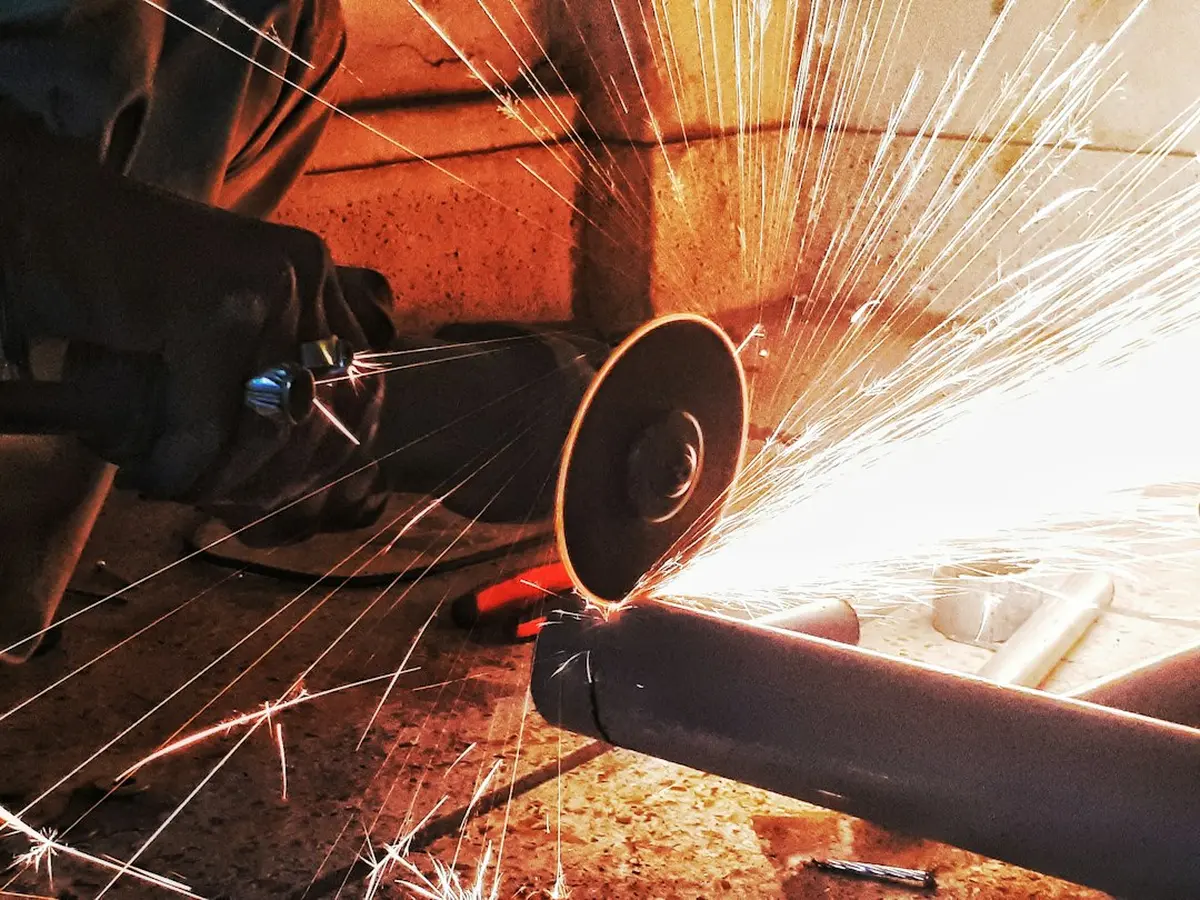
Put a Type 27 grinding wheel on the grinder when you have to knock down a proud bead or hog heavy stock and the finish does not matter. Switch to a flap disc for blending, contouring and anything that has to look finished. The real difference is stiffness. A bonded wheel does not flex, so it cuts the high spot. A coated flap disc flexes and renews itself, so it runs cooler and leaves fewer gouges.
The published record is thinner than the product shelves suggest. None of the sources behind this page publish measured results for specific SKUs: no removal rates, no disc life figures and no prices for the 3M Cubitron II 967A, Walter Enduro-Flex, DeWalt DW8309, DeWalt DW4523, Norton Gemini or Walter HP. The comparison below is therefore between the two tool types and the grains they come in. That is also where most of the actual decision gets made.
The figures side by side
| Specification | Flap disc | Grinding wheel |
|---|---|---|
| Construction, Empire Abrasives | Coated abrasive: overlapping abrasive cloth flaps on a backing plate | Bonded abrasive: grain fused into a resin, rubber or metal matrix |
| How it wears, Empire Abrasives / WorkSafely | Outer flaps wear away and expose fresh grain | Wheel wears down and shrinks in diameter |
| Behavior on high spots, Whitby Abrasives | Flexes away from high spots | Rigid, does not flex away |
| Recommended work angle, Benchmark Abrasives / Whitby Abrasives | T27: 0 to 15°; T29: 15 to 25° | T27: 20 to 30° |
| Heat, Empire Abrasives | Significantly less than a grinding wheel | Higher than a flap disc |
| Stock removal, Weldcote CEO claim | Up to 5x a standard grinding wheel | Baseline |
| Noise, Weldcote CEO claim | About 1/10 of a hard wheel | Baseline |
| Hand-arm vibration, 3M claim (Cubitron 3 1169F) | Lower than standard grinding wheels | Baseline |
| Consensus standard, Norton Abrasives | Separate coated-abrasive framework (EN 13743:2017 internationally) | ANSI/UAMA B7.1-2017 |
| Guard required | Yes (ANSI B7.7, per Benchmark Abrasives) | Yes (29 CFR 1910.215(a)) |
| Pre-use check | Run 1 minute at working speed in a contained area (Benchmark Abrasives) | Visual inspection and ring test (OSHA) |
| Grains named in sources | Ceramic, zirconia, aluminum oxide | Ceramic, alumina zirconia, aluminum oxide (Klingspor bonded line) |
Flap disc
The case for the flap disc rests on its construction. The flaps are cloth-backed, so each one wears through and exposes new grain. Empire Abrasives ties this directly to lower heat and a more uniform blended finish. Whitby Abrasives' technical team puts it as "cooler cut, self-renewing flaps, smoother finish."
The big numbers come from a vendor. In a Fabricating & Metalworking piece, Weldcote CEO Joe O'Mera says "many flap discs remove up to five times the material with less workpiece gouging than standard grinding wheels," at roughly one tenth the noise of a hard wheel. The same article says a nylon backing plate trimmed during use can extend disc life by up to 65%. The piece publishes no test method. It does not name the grit, the grinder, the applied load or the steel, and it does not say which "standard" wheel was used. To verify the claim you would need weighed removal per minute from both tools on the same grinder, at the same load, on the same plate. Nobody in this record has published that.
The disc comes in 2 to 7 inch sizes and in flat, conical and compressed shapes, with fiberglass, plastic or metal backings. Flap density changes how aggressive it is. Weiler Abrasives sells angled flap discs pre-shaped for fillet welds, with phenolic backing to stop flaps ripping in 90 degree joints.
The weaknesses are also documented. The flex that protects the surface lets the disc ride over a high spot. Coated discs are sensitive to storage: Benchmark Abrasives specifies 60 to 80°F at 40 to 50% relative humidity, kept off concrete floors. A Weld Support Parts post lists moisture from unheated containers and service trucks as one of five causes of disc failure. The only price comparison between the two types comes from a vendor: Benchmark Abrasives lists ten of its 4-1/2 inch T29 zirconia flap discs at $25.19 against $28.34 for 25 of its T27 grinding wheels.
Buy the flap disc if most of your grinding ends with a surface someone will look at.
- Runs cooler than a bonded wheel (Empire Abrasives)
- Self-renewing flaps and a smoother, more uniform finish (Empire, Whitby)
- Vendor-claimed lower noise and vibration (Weldcote, 3M)
- Shape options for fillets and contours
- Flexes away from high spots, so it is weaker at knocking down a bead (Whitby)
- Backing and adhesive degrade with humidity and temperature swings (Benchmark, Weld Support Parts)
- Headline removal figures are vendor claims with no published method
Grinding wheel
The bonded wheel's advantage is that it will not back off. Whitby Abrasives recommends a Type 27 depressed-center wheel, held at 20 to 30 degrees, for heavy stock removal and bead knock-down. Its reason is that the rigid structure stays on the high spot where a flap disc would flex. Empire Abrasives also assigns heavy stock removal to the wheel.
The costs are heat, gouging and noise. Empire says a wheel runs hotter, which is what discolors and warps soft metals. Whitby says it leaves deeper gouges that a follow-up pass has to remove.
One figure needs a caveat. Whitby also cites roughly 25% lower Ra and 18 to 50% less tool wear from engineered bond structures. Those numbers compare engineered wheels against standard wheels, not wheels against flap discs. The same applies to the "up to 20x life" figure from United Abrasives that Whitby cites, which compares flap discs against fibre discs. Neither belongs in a flap-disc-versus-wheel argument, although both get used there.
If the wheel runs on a bench or pedestal grinder, it brings more compliance work. Under 29 CFR 1910.215, the work rest must stay within 1/8 inch of the wheel and the tongue guard within 1/4 inch. The work rest gap widens as the wheel wears down, and WorkSafely names that as a common citation trigger in small shops. On price, Benchmark Abrasives lists a 25-pack of 4-1/2 inch T27 depressed-center grinding wheels at $28.34, against $25.19 for a 10-pack of T29 zirconia flap discs.
Buy the grinding wheel if you remove heavy stock before welding and the surface will be covered, painted or ground again anyway.
Where they part company
Three differences hold up against the figures.
Stiffness decides who wins on removal. Weldcote's 5x claim and Whitby's wheel-first workflow contradict each other only if both describe the same job. Whitby's argument is about a specific geometry: a bead or high spot that a flexible tool rides over. On flat, open stock with no high spots to chase, a coarse disc's continuous fresh grain can plausibly outcut a glazing wheel. On a proud bead, the rigid tool cuts where the flexible one skims. That is a mechanism, not a measurement. It is still more than the 5x number comes with.
Heat decides the finish and the soft metals. Every source that addresses heat puts the flap disc on the cool side. Heat is what discolors stainless and warps aluminum and brass (Empire). The finish advantage mostly comes from that same fact.
Grain matters more than disc type on cost. JSH Abrasives, a manufacturer that sells ceramic, says ceramic grain lasts 3 to 5 times longer than conventional abrasives and cuts labor about 25%, at about 40% more upfront. By its figures, the life gain outruns the price premium. Treat that as a claim until someone publishes cost per pound removed. JSH also says zirconia's micro-fracturing keeps it sharp on carbon steel, and that aluminum oxide is cheap but dulls under pressure. Both hold for either tool type.
Mild steel, stainless and aluminum
Mild steel. Either tool will do. Zirconia is the grain the sources point to for carbon steel. Weiler says ceramic tends to push mill scale around rather than remove it, which can compromise weld strength. That is Weiler's claim, made while selling a zirconia mill scale disc. Klingspor lists the A 624 T Supra as its mild steel grinding disc.
Stainless. Use only dedicated INOX, contaminant-free abrasives, and keep silicon carbide grain off ferrous work (Whitby). Iron contamination shows up later as rust bleed. The flap disc's lower heat also helps here. For TIG seam cleaning, Norton makes 2 and 3 inch non-woven Vortex Rapid Prep mini flap discs aimed at stainless. Klingspor lists the A 30 M SPECIAL as a stainless grinding disc.
Aluminum. The flap disc wins on heat, according to Empire. Loading is the usual problem on aluminum, and no source here measures it for either tool. Klingspor's A 46 N SUPRA is the one bonded disc in the record built for aluminum and non-ferrous metals.
All of this is hand-grinder work. Precision surface and centerless grinding on a machine tool follows different rules.
RPM, guards and the rules both share
The two tools are rated under different consensus standards. Norton notes that bonded wheels fall under ANSI/UAMA B7.1-2017, revised continuously since 1926, while flap discs sit in a separate coated-abrasive framework. On the shop floor the rules are almost identical:
- Speed. The spindle must never exceed the RPM marked on the wheel or disc, and OSHA puts that responsibility on the employer. Weld Support Parts gives the example directly: a 13,300 RPM grinder never gets a disc rated below 13,300 RPM. Whitby cites 80 m/s as a common maximum for hand-held discs. Cordless grinders reach full speed almost instantly, which leaves less margin for error.
- Guards. OSHA requires guards on wheels. Benchmark, citing ANSI B7.7, says grinders with guards are designed to be used with flap discs and that the guard stays on.
- Size. A 7 inch disc goes on a 7 inch grinder (Benchmark).
- Pre-use checks. Wheels get a visual inspection and a ring test. Flap discs get one minute at working speed in a contained area. Discard any disc with a cracked backing, missing flaps, warping, heat discoloration or water saturation.
Verdict
If you grind welds for a living, you need both tools, and you use them in order. The bonded Type 27 wheel goes first to knock the bead down. A 40 to 60 grit flap disc blends it, then 60 to 80 grit finishes it. If only one tool comes home, make it the flap disc. It does the blending and finishing that a wheel cannot. A wheel's one clear advantage, cutting a stubborn high spot, is a job a coarse disc can finish slowly. None of the named SKUs has published measured data, so choose by grain: zirconia for carbon steel, ceramic for high volume if you accept the maker's life figures, aluminum oxide only when price is the whole decision.
-
Proud bead, bevel or heavy stock, finish irrelevant
Type 27 bonded grinding wheel at 20 to 30 degrees (Whitby).
-
Weld blending on flat work
Type 27 flap disc at 0 to 15 degrees, 40 to 60 grit.
-
More aggressive blending or contours
Type 29 conical flap disc at 15 to 25 degrees.
-
Fillet welds in 90 degree corners
Angled, phenolic-backed flap disc (Weiler).
-
Carbon steel, general use
Zirconia grain.
-
Stainless
Dedicated INOX abrasive, no silicon carbide; flap disc for lower heat.
-
Aluminum or brass
Flap disc for lower heat, or a bonded disc made for non-ferrous metals such as Klingspor's A 46 N SUPRA.
-
Wheel on a bench or pedestal grinder
Keep the work rest within 1/8 inch and the tongue guard within 1/4 inch, and readjust as the wheel wears.
-
Before mounting anything
Disc RPM rating at or above grinder spindle speed, guard installed, diameter matched.
Comments
No comments yet. Be the first to comment!
Leave a Comment