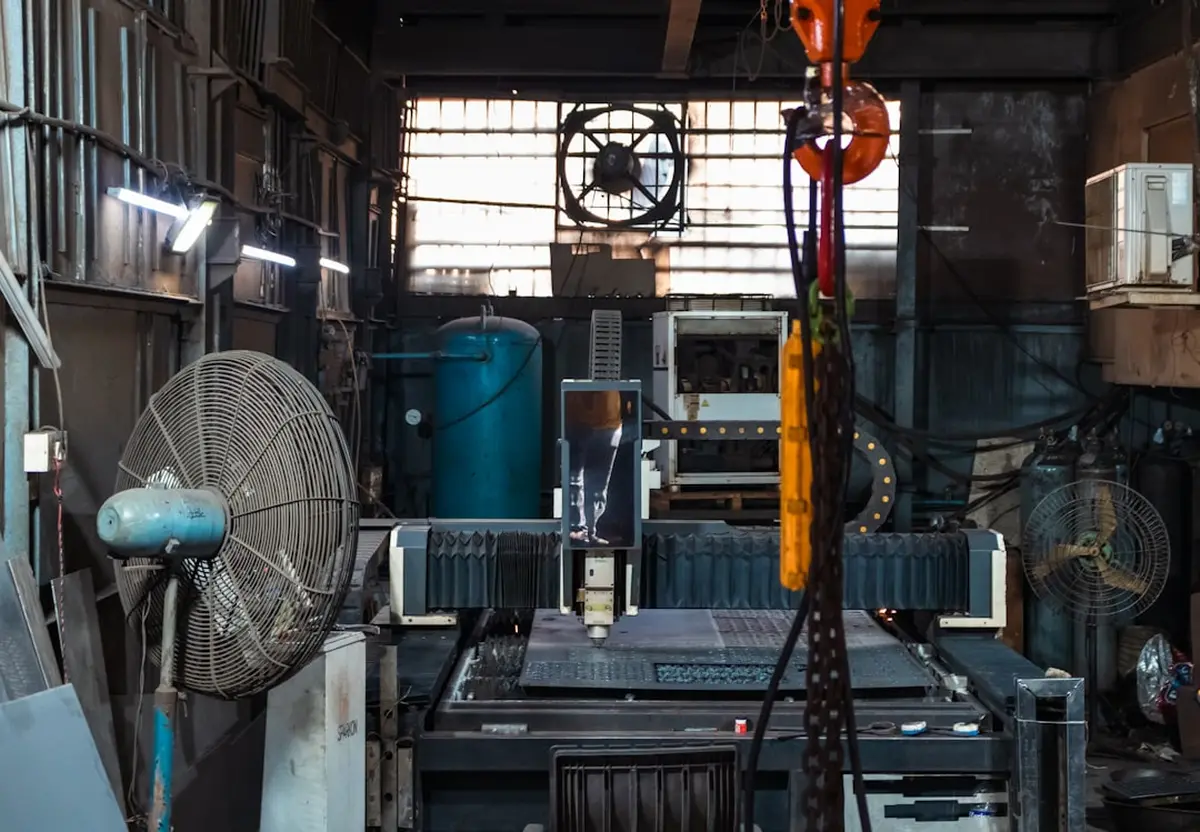
For a shop running three to eight machines, shop floor automation means four purchases that get sold as one: something that loads and unloads a spindle, something that moves material between machines, software that knows what every machine is doing, and a payment structure that keeps the whole thing off a line of credit. They are separable. Shops that treat them as separable tend to get a working cell; shops that buy the bundle tend to get a robot with a dust cover on it.
The thing most first-time buyers get wrong is the budget, and they get it wrong in a specific and predictable direction. A cost breakdown published by GrabaRobot puts the arm itself at 40 to 50 percent of the cost of a fully deployed cell, with the balance going to integration, end-of-arm tooling, the safety assessment, service, and spare-parts logistics. Standard Bots, which sells cobots and therefore has no incentive to inflate the number, puts installation and programming at 20 to 50 percent on top of the arm price and grippers at $5,000 to $25,000 in its 2026 buyer's guide. A $40,000 quote is not a $40,000 decision. It is somewhere between a $65,000 and an $85,000 decision, and the difference is the part nobody puts on the booth banner.
How the pieces fit together
Machine tending is the entry point because it is the only automation task in a job shop where the payback arithmetic is legible. A machine that runs 8.5 hours a day runs 15 with a tender, according to figures Modern Machine Shop compiled in its IMTS 2026 automation preview (September 2026). The mechanism is not clever: the robot takes a raw blank from a tray or a bin, opens the door, loads, closes, cycles, unloads, repeats until the tray is empty. Everything hard about it lives in the fixturing, the part presentation, and whether your chip evacuation is good enough that the robot is not loading onto a bed of swarf.
There are two routes to it. The first is a standalone arm on a pedestal or a cart, which is the cobot pitch: Universal Robots, Kuka and Yaskawa Motoman all demonstrated touch-to-teach programming at IMTS 2026, and RoboJob showed its Turn-Assist cell tending a CNC lathe on HM Manufacturing's stand. The second is a loader built into the machine. Mazak, Okuma, Murata and United Grinding all offer gantry loaders or integrated robots as factory options, per the show's roundup of robotic solutions, and they consume almost no extra floor space because the builder already designed the envelope. If you are buying a machine anyway this year, the integrated loader is usually cheaper than bolting a cell around the machine afterwards, which is worth weighing against the CNC hardware debuting at IMTS this week.
Material movement is the second layer and the one small shops consistently buy too early. The distinction that matters is between an AGV, which has followed a fixed path since the 1950s using magnetic tape, wire, an optical line or QR codes, and an AMR, which appeared in the 1990s and maps its surroundings with LiDAR and sensors. IMTS's own explainer is unusually blunt about the consequence: an AGV that meets an obstacle stops and waits for a person. In a shop where a pallet of bar stock lands in the aisle twice a week, that is a robot that requires a babysitter.
The third layer is data, and it is the one that costs least and gets deferred most. Machine monitoring platforms pull spindle uptime, cycle times, alarms and feed rates off the controls; MachineMetrics, Datanomix, JobPack, Harmoni, Digital Way and RER Software were all in the East Building at IMTS 2026 doing exactly that, alongside MES and scheduling tools from Amper, Tebis and Excellerant, per the show's digital solutions roundup. MTConnect is the translation layer that lets machines from different builders report into the same system.
MTConnect translates data so your whole shop speaks one language.
| Cobot tending cell | AGV | AMR | |
|---|---|---|---|
| Entry price (IMTS and Standard Bots, 2026) | $10,000 to $25,000 for an entry-level arm, before tooling and integration | About $15,000 installed | Frequently over $100,000 |
| How it is taught or guided (IMTS, Sept 2026) | Touch-to-teach, hand-guided lead-through | Fixed path: magnetic tape, wire, optical line or QR codes | LiDAR, sensors and AI, dynamic mapping, no fixed infrastructure |
| Vendor-claimed time to first motion (MMS, Sept 2026) | Operational by noon on the day it arrives | Not stated; path infrastructure has to be laid first | Days, per the claim made for Boston Dynamics' Stretch |
| Behaviour when something blocks it (IMTS, Sept 2026) | Not applicable; the cell is fixed | Stops and waits for manual intervention | Re-routes around the obstacle on its own |
| Where it fits (IMTS and MMS, Sept 2026) | Repeat part families on one or two machines | Stable layout, predictable and repeated routes | Layout that changes frequently |
| Cited example | Dynamic Group, three UR10s, ROI in 2 months (reported by the cobot vendor) | MūL Technologies MARC cart, $20,000 against a projected $24,000 a year in wages | Boston Dynamics Spot, $75,000 at its 2020 debut, 2,000+ deployed, used by Nestlé Purina for packaging-line inspection |
Building the first cell
-
A part family that already repeats
The sources do not give a volume threshold, and any vendor who gives you one without seeing your job mix is guessing. What matters is that the same setup comes back.
-
Baseline machine data you did not estimate
Spindle hours per day, per machine, measured. Without it you cannot prove the cell worked, and you cannot argue with the finance company later.
-
Fixturing and part presentation you trust
Grippers are rated for specific loads. Schunk showed an adhesive gripper rated to 35 pounds at IMTS 2026; FANUC showed a 500 kg arm. Most job shop parts are nowhere near either end.
-
A safety assessment in the budget, not in the hope column
It is one of the line items GrabaRobot identifies as sitting outside the arm price.
-
Somebody who will own the cell
Not a committee. One person who is responsible for it running on a Tuesday afternoon.
-
A financing decision made before the quote, not after
0 percent terms, monthly Robots-as-a-Service and outright purchase produce very different answers to 'did this pay off'.
1. Instrument the machines before you automate them. Put monitoring on the controls and let it run for a month. You should see actual spindle utilisation, which for most shops lands well below what the whiteboard says. Cost: the software subscription and an afternoon of setup. This step is skippable only if you enjoy arguing about whether the robot helped.
2. Call your MEP centre. NIST runs roughly 1,400 advisers across more than 450 locations, and on 15 September 2026 it awarded more than $30 million to 12 centres across 11 states and Puerto Rico explicitly to push robotics, automation, AI and additive adoption at small and mid-sized manufacturers. The advisory conversation is cheap or free. Cost: a phone call.
3. Pick the machine, not the robot. Choose the one machine whose queue is longest and whose parts repeat. What you should see: a shortlist of two or three part numbers you could run unattended tomorrow if someone were feeding the door.
4. Decide tended-arm versus integrated loader. If the machine is old and staying, an arm. If you are replacing it inside twelve months, price the builder's gantry option instead. Cost: nothing but the discipline to wait.
5. Get the quote itemised. Arm, end-of-arm tooling, integration, safety assessment, training, service contract, spares. If the integrator will not break it out, you are about to discover the missing 50 to 60 percent later. Standard Bots' published tiers put its Spark at $29,500 for 7 kg and 900 mm reach, Core at $37,000 for 18 kg, and Thor at $49,500 for 30 kg, which is a useful yardstick for whether a quote is in the right postcode.
6. Program it yourself during evaluation. Touch-to-teach and hand-guided lead-through exist precisely so that a shop without a robotics engineer can do this. Hirebotics CEO Rob Goldiez put it as "Get hands-on and try the programming yourself" in the Modern Machine Shop preview, and it is the single best filter for whether a system suits your people. What you should see: your setup person teaching a pick and place inside an hour, without a laptop.
7. Run it attended first. Same shift, operator present, for as many cycles as it takes to see every way the part can present itself wrong. What you should see: crashes and misloads, now, while someone is watching.
8. Then move it to the unattended shift. This is where the return lives. Modern Machine Shop's preview reports that 71 percent of top-performing shops run unattended operations, which is a statement about where the top performers put the hours, not a claim that lights-out is easy.
9. Only then look at material movement. A mobile robot that ferries totes between a cell that already runs unattended is buying you something. A mobile robot delivering to a machine that still needs a human at the door is buying you a tidier aisle.
Where it goes wrong
Budgeting the arm and calling it the project. Covered above, but it is the failure the cost analyses keep returning to. Recognise it when the quote is a single number. Fix it by demanding the line items, then adding the safety assessment if it is absent.
Single-shift economics. GrabaRobot's model puts cobot operating cost at $7.23 an hour on one shift, $4.19 on two and $3.37 on three, against a fully loaded US manufacturing labour rate modelled at $43.31 to $45.45 an hour. Those are the blog's own assumptions and worth rebuilding with your numbers, but the shape of the curve is the point: the machine is roughly twice as expensive per hour if you only run it while people are in the building. A cell justified on one shift is a cell justified on the weakest version of its own case.
Buying an AGV for a shop that moves its furniture. The symptom is a robot that halts three times a shift and a laminated sign asking people not to leave pallets in the aisle. IMTS's guidance is to pick the AGV only when the layout is stable and the workflow predictable, and the AMR when it is not, which is honest given that the AMR costs several times more.
Taking case-study paybacks at face value. Standard Bots reports a Dynamic Group deployment of three UR10 cobots returning ROI in two months. Modern Machine Shop's preview cites Gimbel Automation averaging seven weeks. Both may be true of those installations. Neither tells you anything about yours, because neither discloses part volume, labour rate, shift pattern or what the cell cost fully deployed. Verifying it independently means one thing: your own measured spindle hours before and after, on the same part numbers. If you skipped step one, you cannot do that.
Reading deployment-time claims as production-ready claims. "Operational by noon" means the arm is moving under its own program. It does not mean the fixturing is validated, the gripper handles a warped blank, or the cell has passed a risk assessment. Vendors are describing setup time and readers hear commissioning time.
Deferring the data layer until after the robot. MES and monitoring are described at IMTS as the foundation the rest of the automation sits on, and a conference session on the show programme on 17 September 2026 was built entirely around using MES to find bottlenecks before touching hardware. The practical failure mode is subtler than a broken robot: you automate the wrong machine, because the bottleneck was two operations downstream and nobody had the data to say so.
Cases that change the answer
Your state, this year. The September 2026 MEP awards were not national. Pennsylvania's IRC Network took $6,110,684 and the Ohio Manufacturers' Association Educational Institute $6,076,983, with Georgia Tech Research Corporation at $3,227,001, Massachusetts MEP at $2,959,870, the University of Missouri at $2,656,601, Alabama's Training Network at $2,191,702, Louisiana's Department of Economic Development at $1,537,719, the University of Utah at $1,492,598, Arkansas' Division of Workforce Services at $1,291,618, Puerto Rico Manufacturing Extension at $939,133, Montana State at $839,900 and Vermont State Colleges at $812,300. Every recipient has to find at least 50 percent in non-federal matching funds under a five-year cooperative agreement reviewed annually. If you are in one of those states, the local centre has money earmarked for exactly the conversation you are having. If you are not, the national adviser network still exists.
Welding rather than machine tending. The economics diverge because the skill being replaced is scarcer and the process variables are nastier. Hirebotics showed welding cobots with hand-guided lead-through programming at IMTS, and the labour case is the sharper one: Standard Bots cites an average US skilled welder age of 55 and a National Association of Manufacturers projection of 2.1 million unfilled manufacturing jobs by 2030. Both are secondhand through a vendor blog and should be treated as such. We have run the numbers on cobot welding against traditional automation separately, because the comparison does not reduce to the machine-tending one.
Payload extremes. Between Schunk's 35-pound adhesive gripper and FANUC's 500 kg arm sits almost everything a job shop makes. If your parts are at either boundary, the entry-level price tiers stop applying and the tooling cost stops being a rounding error.
How you pay for it. At IMTS 2026, Universal Robots was offering 0 percent financing, Formic Technologies was promoting both 0 percent and a no-CapEx Robots-as-a-Service model, and Productive Robotics was advertising packages under $1,000 a month with zero down and same-day approval, per Modern Machine Shop. These are offers dated to the show, not standing rates, and a subscription that never ends is a different animal from a note that amortises. RaaS makes the first cell easy to say yes to, which is the point of it and also the thing to watch.
Bin picking versus tray presentation. FANUC demonstrated 3D vision-guided bin picking and Vention sells modular bin-picking cell frames, which solves the unstructured-parts problem at the cost of adding a vision system to your list of things that can be out of calibration. Trays are dull, cheap and work.
The money, and what the figures are worth
The operational figures circulating at IMTS 2026 come from Modern Machine Shop's preview and are presented without a named underlying study, so treat them as directional rather than audited: daily machine use rising from 8.5 to 15 hours, sales per machine from $183,000 to $350,000, scrap from 2.4 to 0.9 percent, first-pass yield from 90 to 95 percent, on-time delivery from 86 to 94 percent, and sales per employee of $246,140 at high-performing shops against $207,366 at typical ones. The scrap and yield numbers are the ones most worth believing, because consistency is what a robot is genuinely better at than a person at 2 a.m.
Adoption is still a minority position. The same preview puts SME automation adoption at 37 percent and job shop adoption just above 30 percent, in a country where 93 percent of manufacturers employ fewer than 99 people. SME's coverage of the show cites Association for Advancing Automation figures showing US industrial robot installations up 11 percent year over year to 38,000 units, against 295,000 deployed in China in 2024, more than half the world's total. US robot density sits at 307 per 10,000 manufacturing employees, eighth globally, behind South Korea at 1,220 and Germany and Japan at roughly 450 each. Global density was 162 per 10,000 in 2023, more than double the level seven years earlier.
Read together, those numbers say something specific about where the marginal advantage now lies. The US is not short of robots because they are unaffordable; it is short of them because the shops that make up 93 percent of the sector have not bought any, and 37 percent adoption in a market with $15,000 AGVs and sub-$1,000-a-month cobot packages is a distribution problem, not a technology one. The IMTS 2026 Automation Sector alone carried more than 260 exhibitors, with automation spilling into pavilions beyond it. Nobody is struggling to sell you this. The constraint is on your side of the table.
Comments
No comments yet. Be the first to comment!
Leave a Comment