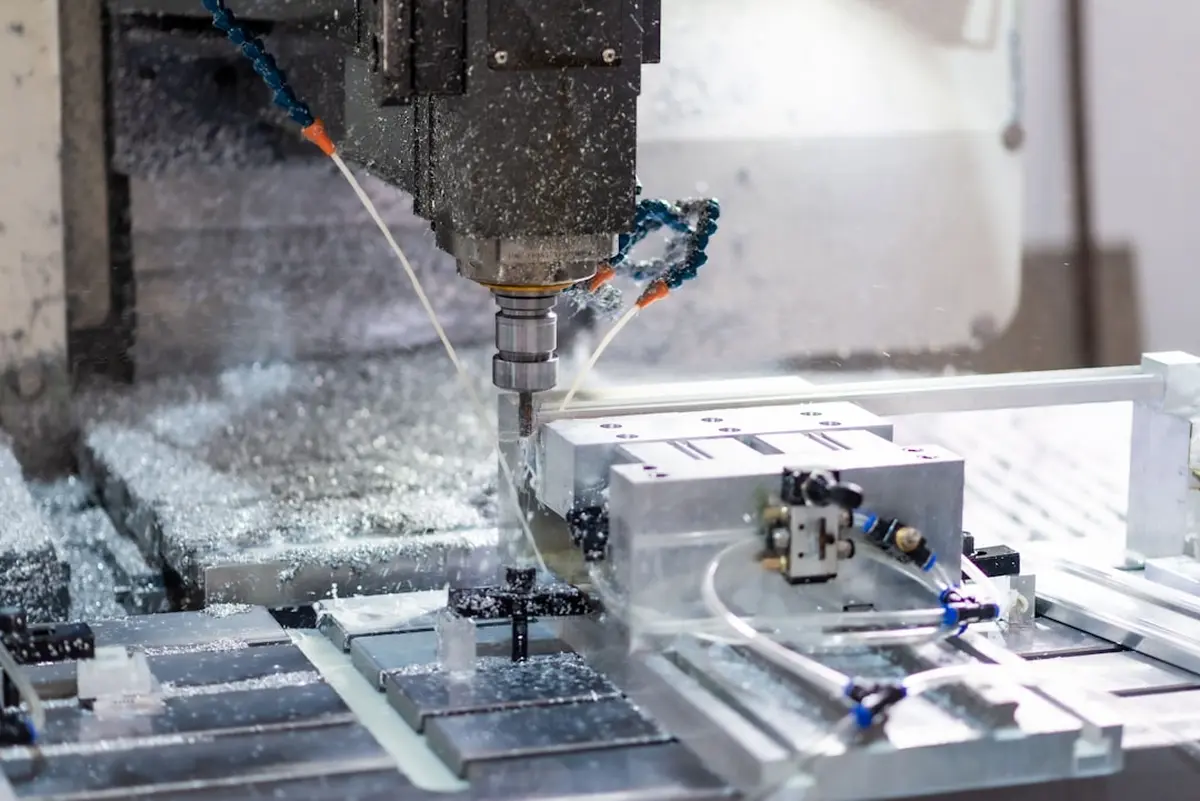
Eleven Okuma machines, four of them Americas debuts, an Integrex that grinds, and two Index/Traub machines North America has not seen in the metal: IMTS 2026 opened this morning at McCormick Place and runs through Saturday, September 19. The show's own preview puts the floor at 1,800-plus exhibitors and expects 89,000-plus attendees, and it leans hard on AI as the organising theme, which is a fair description of the software booths and a slightly generous one for the iron.
The macro case for walking the floor with a chequebook is better than it was two years ago. AMT reports manufacturing technology orders of $2.19 billion through April 2026, up 28.9% year over year, with the ISM Manufacturing PMI at 53.3% in June and Q1 labour productivity up 3.2%. Capital is moving again. What follows is the hardware worth the walk, and what each machine actually changes for a shop writing a purchase order.
The debut list, at a glance
| Machine | Builder / booth | Debut status | Headline capability |
|---|---|---|---|
| MULTUS U1000 | Okuma, #338500 | Americas debut | Multitasking lathe, shown alongside the U2000 |
| LT2000 EX | Okuma, #338500 | On stand | 6-in chuck twin-spindle, 2 or 3 turrets, 32 or 48 tool stations |
| INTEGREX i-350S NEO | Mazak, #236700 and #338300 | New model | Turning, milling and grinding in one setup, 10-in chuck |
| VC-Ez 20 | Mazak | New model | 40-taper VMC, 12,000 rpm, footprint 26.5% smaller than comparables |
| TRAUB MS12-4 | INDEX, #339119 | North American debut | Four TNL12 sliding-headstock lathes in one frame |
| INDEX G160 | INDEX, #339119 | North American debut | 5-axis turn-mill, 42 or 65 mm bar clearance, B-axis milling spindle |
| STUDER S23 | United Machining Solutions, #236802 | First IMTS showing | Universal cylindrical grinder, 650 to 1,000 mm between centres |
| DNX 2100SB | DN Solutions | New model | Twin turning spindles, 0.0001-degree indexing, Ø520 x 1,100 mm |
Okuma fills 17,000 square feet and hides the interesting part in the control
Okuma's stand is 11 machine tools across machining centres, lathes, multitasking lathes and grinders, with four Americas debuts: the MB-100V VMC, the GENOS M4000H-e horizontal, the MS-320H horizontal, and the MULTUS U1000 multitasking lathe. The U2000 and the LT2000 EX round out the turning side. Nine of the eleven machines are paired with automation, ten distinct automation systems are on the floor, and three Okuma Factory Automation developments make their Americas debut, per the company's release. There is also an Intrinsic AI robot cell, a VR rig for models Okuma did not ship to Chicago, and a display about the 35,000 square foot repair centre in Charlotte. The media event is Tuesday at 2:00 PM CST.
The detail worth noticing is the control split. Nine of the eleven machines carry the OSP-P500, and Okuma has free-standing simulators so you can push buttons without queuing behind a demo part. The LT2000 EX is not one of the nine: it runs the open-architecture OSP-P300 with the Easy Operation interface that groups common processes into single entries. That is not a defect, it is a position in the refresh cycle, and it is the kind of thing to establish before you sign rather than after. Ask the applications engineer which control ships on the configuration you are quoting, not the one on the show floor.
On the LT2000 EX itself: 6-inch chuck class, twin spindle, available in two or three turret versions, with or without Y-axis. Twin turret gives 32 tool stations, three turrets gives 48. For a shop running families of small turned parts with a lot of live tooling, the third turret is the difference between one setup and two, and it is worth pricing both ways.
Mazak adds grinding to the Integrex, which is the real news
The INTEGREX i-350S NEO and i-350ST NEO are the first Integrex models to put grinding alongside turning and milling in one setup. Mazak first showed the series at its DISCOVER 2025 event on September 30, 2025; this is the IMTS outing, split across booths #236700 in the North Building and #338300 in the South.
The numbers: main and second turning spindles at 4,000 rpm, main spindle taking a 10-inch chuck, milling spindle standard at 12,000 rpm and 24 hp (22 kW) with a 20,000 rpm option for aluminium and small-diameter work. X stroke is 27 inches, Y is 12 inches, maximum part diameter is 26.38 inches (670 mm), and length runs to 59.80 inches on the 1500U bed or 98 inches on the 2500U. A front-mounted tool magazine keeps the load zone clear for gantry loaders, bar feeders and robots.
Grinding on a turn-mill is not new as a concept. What matters is whether the machine holds the finish and size that justify skipping a dedicated cylindrical grinder, and no show-floor demo settles that. The honest test is a Cpk study on your own part, in your own thermal environment, over a full shift. Mazak's answer to the thermal half of that is Ai Thermal Shield, which the company describes as adapting to ambient temperature change without operator input. Take the ambient-swing data from the demo cell with the scepticism it deserves: McCormick Place in September is not a shop in February.
The quieter Mazak launch is the VC-Ez 20, a compact 40-taper VMC with a 12,000 rpm, 18 kW standard spindle, a 30-tool magazine (50 optional) and a footprint reported as 26.5% smaller than comparable models. The optional spindle is listed as 15,000 rpm and 22 kW with "110 kW torque," which is not a unit of torque and is presumably a transcription casualty somewhere between the spec sheet and the trade coverage. Get the torque curve in writing.
Four lathes in one frame: the Traub MS12-4
INDEX is at #339119 in the South Building with two North American debuts. The TRAUB MS12-4 is the more unusual of the pair: it is four TNL12 single-spindle sliding-headstock lathes built into one machine, with four primary spindles, four tool turrets, two or four counter spindles and up to four Flex-WT flexible tool carriers. Each station finishes a complete part concurrently, which is a different proposition from a drum-style multi-spindle where the part indexes through stations. INDEX points at long, thin components such as bone screws, and that is exactly the geometry the architecture suits.
The INDEX G160 gets its first North American demonstration on the same stand: dual direct-drive spindles on a vibration-damping bed, bar clearance of 1.64 inches (42 mm) or 2.56 inches (65 mm), an upper tool carrier carrying a B-axis and direct-drive milling spindle for true five-axis work, and two lower turrets that can serve either spindle. An upper turret can replace the milling spindle if your part mix does not need the B-axis, which is a useful configuration fork to have priced before you arrive.
Also on the stand: the MS24-8 drum-style multi-spindle with eight main spindles, the G320 turn-mill (55.1 inches of turning length, 9.8 inches diameter), three TNL20 variants, and the C200 with INDEX's SingleSlide system, which the company credits with up to 30% longer tool life. That figure is a vendor number against an unstated baseline. Ask what insert grade, what material and what the comparison machine was, because a 30% improvement measured against a poorly damped slide is a statement about the old slide.
Cycle time reduction is vital, but it alone can't get a company to maximum profitability
Studer's S23 is the grinder for shops that thought grinders were out of reach
The STUDER S23 universal cylindrical grinder makes its first IMTS appearance at the United Machining Solutions booth, #236802 in the North Building, paired with US-built flexLoad automation. Distance between centres is 25.6 to 39.4 inches (650 to 1,000 mm), centre height is 6.9 inches (175 mm). The wheelhead swivels automatically on a B-axis with a 1-degree Hirth coupling and takes up to two external wheels plus one internal, or three tools total in the production wheelhead configuration. Base is Granitan composite for thermal stability and damping, spindles are frequency-controlled motor or belt drive, and the whole thing runs on Studer's C.O.R.E. hardware and software architecture with StuderWIN and QuickSet.
The pitch, per New Equipment Digest, is a machine that works for one-off tool room jobs and for series production, at an accessible price point. No price has been published, so "accessible" remains a word rather than a number. The three-tool wheelhead is the specification that earns its keep: it is the difference between grinding an OD, a shoulder and a bore in one clamping and chasing concentricity across three setups.
United Machining Solutions is showing 18 machines in total, nine of them new, five new to IMTS and four global unveilings, including the BLOHM PROFIMAT MC5 5-axis grinder. The opening ceremony was scheduled for this morning at 10:15 with five machines shown for the first time anywhere.
The control and CAM story
Every builder on the floor is saying "AI" this week, and the claims fall into three fairly distinct buckets. Programming automation is the first: Mazak's Solid MAZATROL generates machining programs from 3D models, Heidenhain's TNC7 adds interactive automation tools and an AI chatbot for operator support, and Hexagon has put ProPlanAI into Esprit Edge, using historical machining data to suggest processes for new parts so that less experienced programmers get closer to expert output. That last claim is testable, and the test is whether it suggests anything sensible for your part when it has no history from your shop.
The second bucket is in-process adaptation: SMOOTH Ai Spindle taking sensor feedback to trim spindle speed for vibration and finish, and Ai Thermal Shield for drift. These are the ones that show up as a better surface on a part you can hold, so hold one.
The third is digital twin. MAZATROL TWINS syncs a virtual machine to the physical one, SMOOTH Project Manager handles job setup, and INDEX has iXworld with its iX4.0 productivity apps, an iXservice portal and iXshop for procurement. Useful, and also the layer most likely to be sold as a subscription. Ask what expires.
For shops running one to five machines, the CAM seat usually constrains you more than the control does, and the packages small shops actually run will determine whether any of this AI programming reaches your spindle at all. Autodesk is showing AI features in Fusion aimed at design exploration and repetitive task automation. Beyond Heidenhain, Hexagon and Autodesk, the show's official materials do not detail which CAM vendors are demonstrating AI-assisted programming across multiple post environments, so treat any multi-CAM claim you hear on the floor as something to verify with your own post processor and your own part file. The Industrial AI Arena, with 32 exhibitors plus Sandia National Laboratories, is the concentrated version if you only have an hour.
IMTS 2026 gives manufacturers direct access to AI experts who understand industrial processes.
Questions buyers keep asking this week
Five days, and most of it is turning
The pattern across the debuts is that the milling side of the show is incremental and the turning side is not. Grinding folded into a turn-mill, four sliding-headstock lathes fused into one frame, a 5-axis turn-mill for 42 and 65 mm bar: those are process-plan changes, not spec bumps. If you are deciding whether to fly out midweek, that is the argument for going.
Booth numbers to save: Okuma #338500, Mazak #236700 and #338300, INDEX #339119, United Machining Solutions #236802. Doors close Saturday, September 19.
Comments
No comments yet. Be the first to comment!
Leave a Comment