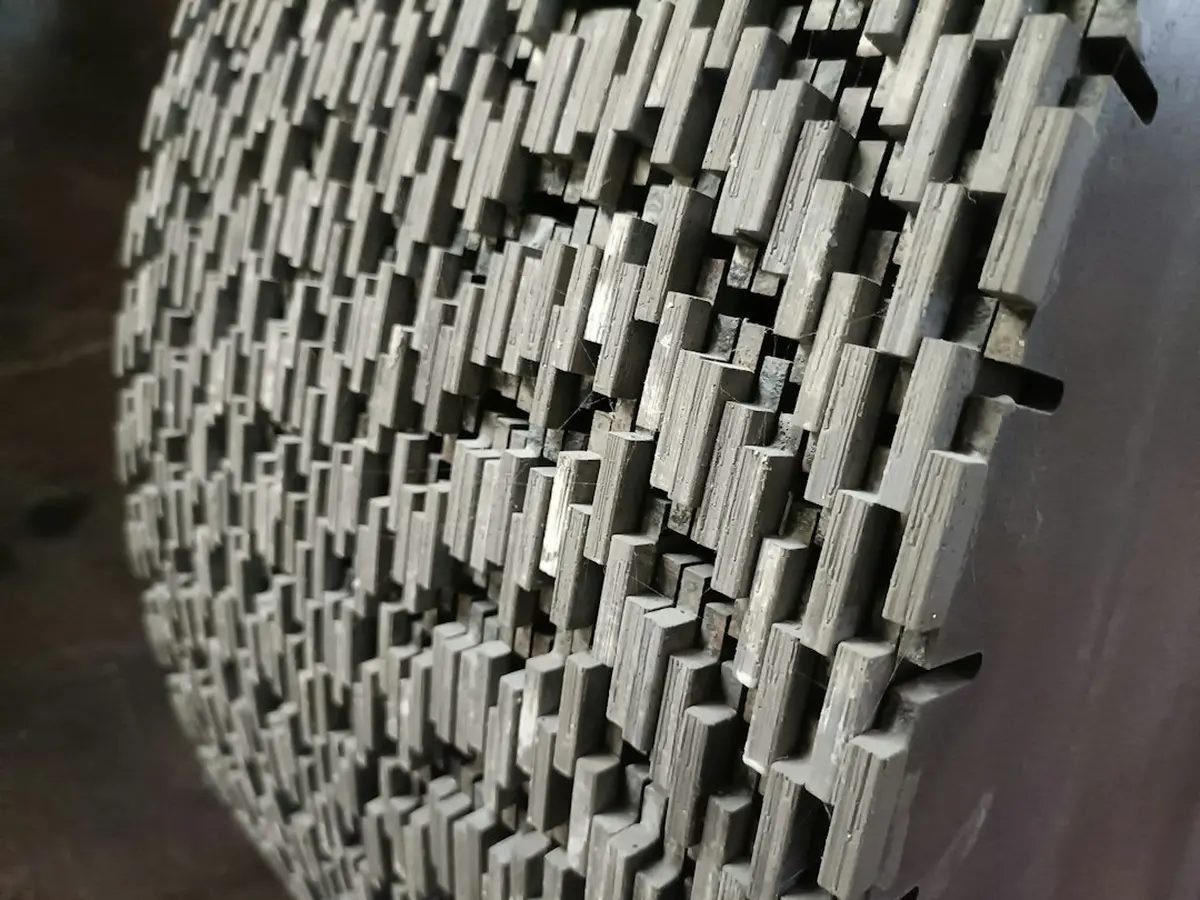
A flap disc grit number sets how fast the disc cuts and how deep a scratch it leaves. Picking a grit means picking the coarsest one whose scratch the next disc in the sequence can still erase. The abrasives makers broadly agree on the bands. Use 36 to 40 for heavy stock removal, 40 to 60 for weld grinding and blending, and 80 to 120 for finishing and prep before paint or coating. Past 120, a coated flap disc stops being the right product. This page is for the person at the rack holding three discs that look the same except for the number on the label. It ties each grit band to a job and a base metal, and it names who published each figure.
The common mistake is to treat grit as speed, start coarse to save time, and plan to clean up later. Norton Abrasives states the cost of that: coarser grit removes material faster but leaves deeper scratches that can be hard to blend out afterward. Norton notes that the problem shows most on stainless, where the finish is the deliverable. Time saved on a 36-grit pass gets spent on extra passes at 60 and 80, or it never comes back.
Grit, grain and shape: what each number controls
Three choices decide how a flap disc behaves: grit, grain and profile. Grit is the headline number and the subject of this page. The other two decide whether that grit performs the way the chart says it will.
Grit. The working range for coated flap discs is 24 to 120 grit, per Cutting Tool Engineering. Whitby Abrasives puts the practical working span at 36 to 120. CTE names 80 grit as the single most popular size on the market. That fits with 80 being fine enough to prep for primer and coarse enough to still flatten a bead. Below 36, CTE makes a point the charts skip. Grits of 36 to 40 can hold their mineral better than ultra-coarse options, so going coarser can mean shelling, where grain comes off the backing before it is used up.
Grain. Grain is the mineral glued to the flaps. Each grain needs a certain pressure, so it changes how a given grit cuts on a given grinder. The three you will see on the rack are compared below. Most of the performance figures come from companies that sell the abrasive, and the table says which ones.
Profile. Type 27 discs are flat and Type 29 discs are conical. Norton and CTE both give the Type 29 flap angle as 15° to 25°. Norton and CTE both recommend Type 27 for blending and finishing flat surfaces at 60 grit or finer. Working angles differ slightly by source. Empire Abrasives gives Type 29 at 15 to 25 degrees and Type 27 at 0 to 15 degrees. Whitby gives Type 27 at 5° to 15°. Supra Industries claims Type 29 discs have 15 to 20% more contact area than flat discs. That is a supplier figure with no published test method behind it.
| Aluminum oxide | Zirconia alumina | Ceramic alumina | |
|---|---|---|---|
| Cost position (Whitby, Supra, CTE) | Lowest cost; Supra calls it the cost-effective choice for smaller jobs | Better cut-rate-to-cost ratio than aluminum oxide (CTE) | Highest unit price; offset by life in continuous production (Dome) |
| Self-sharpening (Whitby, Norton, Dome) | No; blocky, friable grain made in varying qualities (Norton) | Yes, by micro-fracturing under pressure | Yes, continuous micro-fracturing from a uniform microstructure |
| Best-fit metals (Benchmark, Norton, CTE) | Carbon and low-alloy steel, cast iron; Norton adds high tensile aluminum and bronze alloys | Carbon steel, cast iron, stainless; less discoloration on stainless (CTE) | Stainless, high-nickel alloys, titanium (Benchmark) |
| Pressure behavior (Whitby, Dome, Empire) | Burns up and glazes under weld-blending pressure (Empire) | Needs firm, steady pressure; light pressure dulls it and builds heat (Dome) | Glazes on low-power tools without enough pressure (Whitby) |
| Published performance claims (CTE, Dome) | Baseline in most comparisons | Dome: cuts slower and runs hotter than ceramic on stainless | CTE: 2x the cut and up to 10x the life of standard grain; Dome: about 30% cooler and at least 66% faster than zirconia on stainless |
The ceramic figures need a caveat. CTE's "twice as fast and up to 10 times as long" compares ceramic with unnamed "standard abrasive grains," with no grit, metal or load given. Dome Abrasives' 30% and 66% figures come from a manufacturer that sells both zirconia and ceramic discs, and no test conditions are given. Checking them would take matched discs of one grit and density, the same grinder, the same joint, and logged time and grams removed per disc. None of the sources here publish that. The direction is consistent across the vendors (ceramic cuts cooler and faster, then zirconia, then aluminum oxide), but the sizes of the gaps are marketing until someone posts a method.
The grit chart
| Grit | Job | Base metal | Who publishes it |
|---|---|---|---|
| 24 to 36 | Heavy stock removal, thick welds, rough shaping; very rough, deep scratch | Thick carbon steel, cast iron | Garage Welding; CTE (bottom of 24 to 120 range) |
| 36 to 40 | Heavy stock removal, leveling welds, chamfering, heavy bevels, thick rust | Thick carbon steel and cast iron (start at 40 to 60, KTHUA) | Benchmark Abrasives, Whitby Abrasives, KTHUA |
| 40 to 60 | Weld grinding and blending; main pass on fillet welds with a Type 29 | Carbon and stainless steel; cast iron with ferrous-rated discs | Benchmark, Whitby, Empire Abrasives, Garage Welding |
| 60 | Deburring, deflashing, edge chamfering, bevel refinement | Carbon steel; stainless with a stainless-rated disc | Benchmark, Whitby, Garage Welding |
| 60 to 80 | Deburring welds; rust and paint stripping; coating prep; lighter blending | Carbon steel; aluminum at light pressure with non-ferrous, load-resistant discs | Norton (60 or 80 for weld deburring), Benchmark, Whitby, Garage Welding |
| 80 | General weld blending to a primer-ready surface; the common finishing pass after 40 | Mild steel (KTHUA starting grit); stainless at low pressure | KTHUA, Supra Industries, Garage Welding; CTE (most popular grit) |
| 80 to 120 | Finishing, refining scratch patterns, prep before paint or coating | Carbon steel, stainless; aluminum with non-loading discs | Benchmark, Whitby, Garage Welding, Dome Abrasives (stainless) |
| 150 to 240 | Brushed finishes, conditioning, pre-polish; nonwoven or duplex products, not standard coated flaps | Stainless steel, aluminum | KTHUA (180 to 240), Dome (150 to 240 on stainless), Garage Welding; CTE (duplex to 180) |
| 320 and finer | Cosmetic prep and polishing before buffing compounds; other abrasive formats | Stainless, aluminum where a mirror finish is specified | KTHUA, Garage Welding |
The bands overlap because the makers are describing a continuum, and their disagreements are worth knowing. KTHUA starts mild-steel projects at 80 grit, which is finer than most of the others suggest for anything with a bead on it. It calls 80 grit "the undisputed MVP of the metal shop." On aluminum, Garage Welding says 60 to 80 and KTHUA says 80 to 120, and both insist on non-loading discs. Dome writes "mesh" where everyone else writes grit, and its stainless coarse band of 24 to 60 reaches lower than the others recommend for stainless.
Norton's own welding and fabrication selection guide does not stay with flap discs for the last step. It gives 60 or 80 grit flap discs for deburring welds, then moves the lighter finishing work to resin fiber discs at 80 to 120. That is a different product at the same grit numbers, which shows that grit alone does not set the finish.
The Garage Welding summary puts the consensus in one line: "Use 36 or 40 grit for heavy weld and stock removal, 60 grit for general weld cleanup and beveling, 80 grit for blending, and 120 grit for fine surface preparation."
Packs by band. At the counter, the choice usually comes down to a few familiar packs. These include a mixed 40/60/80/120 flap disc variety pack (Benchmark Abrasives and Tolesa both sell this format), 3M Cubitron II 967A in 40+ and 60+ for the coarse and blending bands, Walter Enduro-Flex in 40 and 80 for a two-step weld sequence, and a Scotch-Brite surface conditioning disc for the step past 120. The sources behind this page carry no spec sheets, cut rates or life figures for any of those products, so nothing here ranks them. Check each one's grain, density and maximum RPM on the maker's own sheet. Those are the three properties the sources above say actually set behavior. Grit, grain, shape and density matter more than the brand. Both 3M's Cubitron line and Walter's use premium grain, which puts them in the ceramic or zirconia columns of the grain table rather than the aluminum oxide one, and the claims in that table apply to them on the same terms.
Taking a weld from bead to paint-ready
-
Discs in at least two grits, one coarse and one finishing
For example 40 and 80, or 40 then 60 or 80, per Empire Abrasives' production sequence.
-
The right profile for each pass
Type 29 for the coarse pass on fillets, edges and contours; Type 27 for the finish pass on flat work.
-
Ceramic or zirconia grain for weld blending
Empire reports that aluminum oxide glazes under blending pressure.
-
INOX-marked discs if the job is stainless
Less than 0.1% iron, sulfur and chlorine, kept separate from carbon-steel discs.
-
A disc speed rating at or above the grinder's no-load RPM
Whitby gives about 13,200 to 13,300 RPM for a 4.5-inch Type 27, about 12,500 RPM for a Type 29, about 8,500 RPM at 7 inches.
-
Guard on the grinder and eye protection
OSHA requires guards on portable grinders with no more than 180° of exposure, plus Subpart E eye protection.
Weld bead to coating prep
-
Decide the finish before choosing the first grit
Work backward from the last grit. Primer or powder coat means finishing at 80 to 120. A brushed stainless finish means going past 120 into nonwoven. A structural weld that only needs flush means 60 or 80 may be the end. The finish sets the coarsest grit you can afford to start with, because every grit you start below it adds passes. Worked when: you can name the last disc before the first one goes on.
-
Inspect the disc and mount it
Look for torn flaps, a cracked backing, and the speed marking. OSHA's abrasive wheel rules require close inspection before mounting, a free fit on the spindle with nothing forced, and a nut tightened only enough to hold. Stand out of the plane of rotation while the tool comes up to speed (29 CFR 1910.215). Worked when: the disc spins up with no wobble and no flap contact with the guard.
-
Knock the bead down with the coarse disc
A 40-grit Type 29 at 15 to 25 degrees is Empire's main blending pass on carbon or stainless. Let ceramic and zirconia have the pressure they need to self-sharpen. Stop just proud of the parent metal rather than flush, so the finish disc has something to remove besides your coarse scratches. Worked when: the bead is down to a low crown and the scratch pattern is even, with no blue on the parent metal.
-
Change to the finish grit and profile
Move to a 60 or 80 grit Type 27 at 0 to 15 degrees (Empire) and take the crown flush. The job of this pass is to replace every 40-grit scratch with a shallower one. Supra Industries claims the two-step 40-then-80 sequence cuts total labor by up to 30% against running a single medium grit throughout. That is a supplier figure with no published method. Worked when: no coarse scratches show when you sight down the surface under raking light.
-
Use the step-down method to skip a disc change if the finish allows
CTE describes getting finer results from a coarser disc by easing off the pressure, which works better as the mineral wears. A worn 60 can approach what a fresh 80 or 120 leaves. This saves a disc change on paint-grade work. It does not replace a real finer grit where the finish is inspected. Worked when: the scratch pattern visibly tightens as pressure comes off.
-
Refine to 120, or leave the flap disc
For paint or coating prep, a 120-grit pass or Norton's 80 to 120 resin fiber disc finishes the job. For anything finer, CTE points to duplex flap discs with nonwoven material, available to 180 grit, and KTHUA and Dome put brushed and pre-polish work at 150 to 240. Worked when: the surface is uniform and the scratch is fine enough that the coating spec or the eye accepts it.
None of the sources publish time per step or cost per joint, so neither appears above. The only labor figure anyone offers is Supra's 30%. Testing it in a shop would mean timing the same joint both ways across enough parts to average out the operator.
Where it goes wrong
Starting too coarse. How you know: deep scratches still show under paint or after the finish pass, or you keep adding passes at 80. What to do: start one grit finer next time. Norton's warning about scratches that cannot be blended out is the reason the coarse band stops at 36 to 40 for most jobs.
Aluminum oxide on weld blending. How you know: the disc stops cutting early, the flaps look shiny, and the work heats up while removing little. Mike Germade of Empire Abrasives puts it plainly: "Standard aluminum oxide discs will just burn up and glaze over under the pressure of weld blending, forcing more frequent disc changes." What to do: move to zirconia or ceramic for blending and keep aluminum oxide for lighter, general-purpose work on carbon steel and cast iron.
Premium grain on a weak grinder, or a timid hand. How you know: a zirconia or ceramic disc glazes and runs hot despite its price. Whitby reports that both grains underperform on low-power tools without enough pressure, and Dome says light pressure dulls zirconia and builds heat. What to do: use more pressure if the tool can take it. If it cannot, aluminum oxide may do better on that grinder.
Shelling. How you know: grain comes off the flaps long before the backing is used up, usually in heavy removal. CTE ties it to grit or grain mismatched to the job, and notes that 36 to 40 holds mineral better than ultra-coarse grits. What to do: step up from 24 to 36 or 40, or change grain.
Cross-contaminated stainless. How you know: rust spots appear on stainless days after grinding. Empire attributes this to ferrous particles embedded from discs that were also used on carbon steel. What to do: use INOX-marked discs only, keep them in a separate bin, and never let a disc that has touched mild steel go back on stainless.
Loaded discs on aluminum. How you know: flaps clog with metal and stop cutting. What to do: both KTHUA and Garage Welding call for non-loading or load-resistant, non-ferrous-rated discs and light pressure.
Grinding to hide a bad weld. A flap disc blends a bead flush. It does nothing about porosity or lack of fusion under the surface, and grinding a poor weld flat only hides it. Those weld defects and their causes are a welding problem to fix at the torch, not at the disc.
Stainless, aluminum and other exceptions
Stainless steel. The grit bands barely change. Garage Welding gives 40 to 60 for removal and 80 to 120 for blending, the same as carbon steel, and Supra recommends 60 or 80 grit zirconia or ceramic. What changes is the disc. Empire specifies INOX-marked discs with less than 0.1% iron, sulfur and chlorine. KTHUA says to work stainless at 80 grit with low pressure to avoid heat discoloration, and CTE credits zirconia with less discoloration than aluminum oxide.
304 versus 316. Dome Abrasives splits the grain choice by alloy. Zirconia at moderate pressure is cost-effective for 304. Ceramic is preferred for 316, because the molybdenum causes chip adhesion and concentrates heat, and in Dome's words "Ceramic's micro-fracturing effectively 'sheds' adhered grinding debris." Dome is the only source that splits by alloy this way.
Aluminum. Grit moves slightly finer and the disc must not load: 60 to 80 by Garage Welding, 80 to 120 by KTHUA. Norton lists aluminum oxide as usable on high tensile aluminum and bronze alloys, which is narrower than "any aluminum."
Cast iron. Use 40 to 60 grit with ferrous-rated discs, per Garage Welding, which also flags the dust.
Low-power or cordless grinders. Whitby's note about zirconia and ceramic glazing without enough pressure changes the grain recommendation. On a grinder that cannot load the disc, the cheaper grain may cut better.
A burr, not a weld. For one burr on a small part, a 60-grit disc is a lot of tool, and a mill bastard or second-cut file may finish sooner once setup is counted.
Disc size. Maximum speed drops as diameter grows. Whitby gives about 13,200 to 13,300 RPM for a 4.5-inch Type 27, about 12,500 RPM for a 4.5-inch Type 29, and about 8,500 RPM at 7 inches. Whitby's rule is "Never run a disc above its marked speed."
What it costs and what it is worth
None of the sources give a price for any disc, pack or grain, so there are no dollar figures here. Disc prices are on the distributor's page, and they change faster than a reference page should. The worth question can still be framed with what the sources do say. Aluminum oxide is the cheapest per disc. Zirconia has a better cut-rate-to-cost ratio, per CTE. Ceramic costs the most per disc, and both Dome and Empire argue it pays back through life and speed in continuous production, while Dome calls zirconia the better value for occasional work. Empire's framing is that faster cutting and longer life reduce labor, and in most shops labor costs more than discs. Whether the ceramic premium pays in a particular shop depends on how many hours a week the grinders run, and the only way to know is to count discs and time per part for a month on each grain.
The figures above come from undated manufacturer and trade pages. They are given as those pages stated them when this article was written in October 2026, and the vendor ones are claims, not measurements anyone outside the vendor has published.
Comments
No comments yet. Be the first to comment!
Leave a Comment