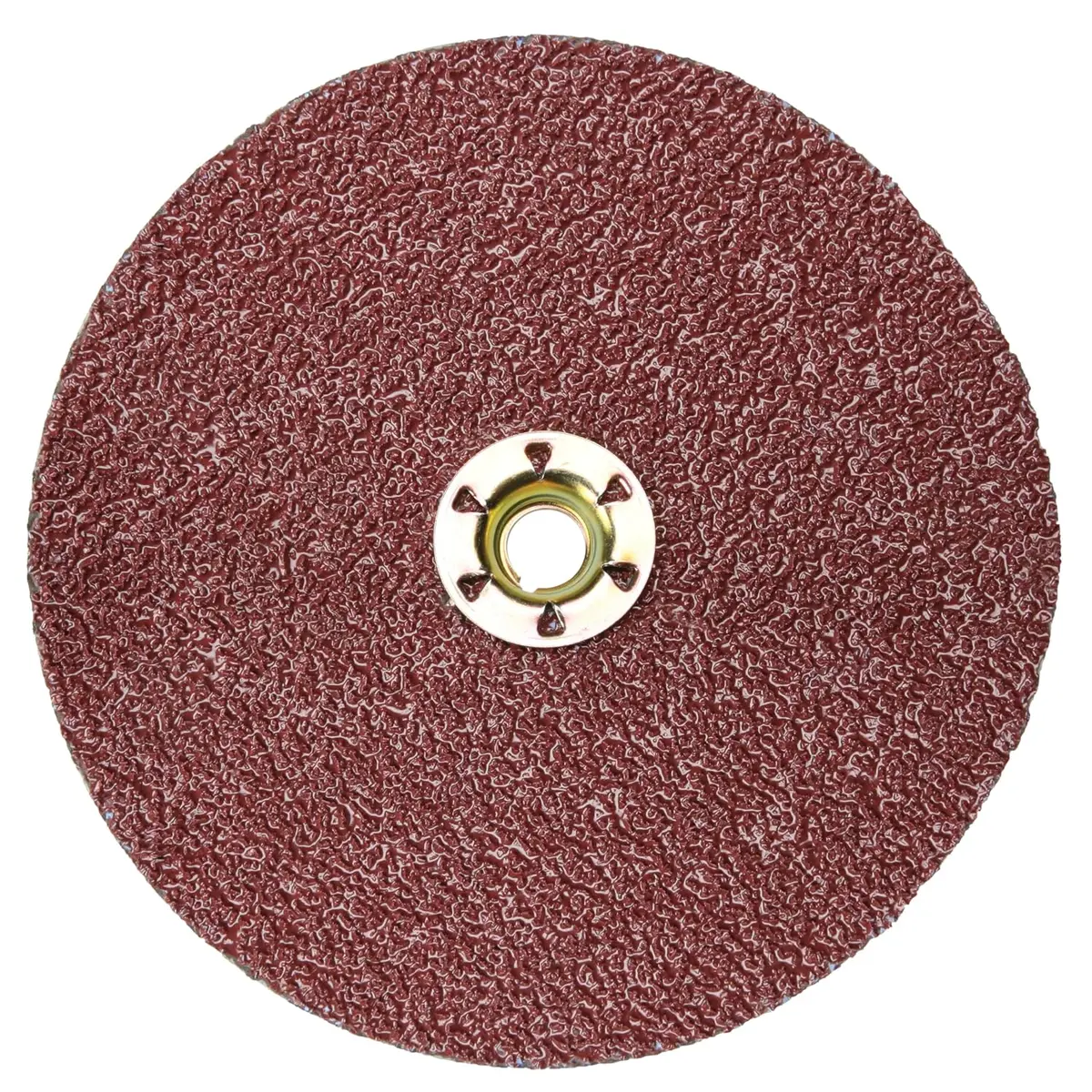
Use a resin fiber disc to knock down heavy welds and strip scale off flat plate. Use a flap disc for everything after that, and for anything thin, curved or stainless. The difference comes from construction. A fiber disc is one layer of grain on a sheet of vulcanized fiber. It needs a backing pad to stay rigid, and it is finished when that one layer is worn. A flap disc stacks overlapping cloth flaps on its own plate, so it exposes fresh grain as the outer flaps wear away.
The products buyers usually set against each other are a 3M Cubitron II 982C fiber disc on a 3M or Walter backing pad, a 3M Cubitron II 967A flap disc, and a Walter Enduro-Flex flap disc. Here is the limit of this page: none of the published sources it draws on reports a measured figure, a test or a retail price for any of those three specific products. Every number below describes the category as a whole, and it comes from abrasive makers and sellers. The page says so wherever that matters.

Walter Enduro-Flex™ Flap Disc, 4-1/2" X 7/8" Grit 40, Pack of 10 …

Cubitron II Fibre Disc 982C, Pack of 25, 4-1/2 in, TN Quick …


Side by side
| Specification | Resin fiber disc (982C type) | Flap disc (967A, Enduro-Flex type) |
|---|---|---|
| Construction, Benchmark Abrasives / Buddies Abrasives | Single layer of grain resin-bonded to vulcanized fiber | Overlapping cloth flaps glued to a fiberglass or plastic backing plate |
| Typical grit range, Buddies Abrasives | 24 to 80 | 40 to 240 |
| Heat generation, Buddies Abrasives decision matrix | High | Lowest of the grinder abrasives rated |
| Contour following, Buddies Abrasives decision matrix | Poor | Excellent |
| Scratch pattern, Buddies Abrasives / Benchmark Abrasives | Pronounced linear scratch | Consistent finish, minimal swirl marks |
| Wear pattern, Benchmark Abrasives | Single layer wears down gradually | Self-renewing: worn flap edges expose fresh grain |
| Relative life, Benchmark Abrasives | Baseline | One premium flap disc = 10 to 15 standard fiber discs |
| Relative life, manufacturer rating cited by Whitby Abrasives | Baseline | Up to 20x |
| Upfront cost, Benchmark Abrasives | Baseline | Up to 300% more |
| Grit when substituting, Benchmark / Whitby | Reference grit | One grit coarser than the fiber disc it replaces |
3M Cubitron II 982C fiber disc
The 982C is a resin fiber disc, so the category's behavior applies to it, and so does the category's main requirement: it does nothing useful until it is bolted to a backing pad. Benchmark Abrasives matches the pad to the grit:
- 24 to 36 grit: a hard, ribbed pad for heavy stock removal
- 60 to 80 grit: a medium flat pad for shaping
- 100 to 120 grit: a flexible flat pad for surface prep
That makes the pad part of the purchase. It is not an accessory you can skip.
What the format does well is bite. Benchmark describes the cutting action as immediate and aggressive. Whitby Abrasives calls the fiber disc the most aggressive coated abrasive. The Buddies matrix rates it excellent for stock removal speed on flat surfaces.
The cost of that speed shows up on the part and in the operator's hands:
- Heat. All the heat goes into one abrasive layer, which raises the risk of discoloration on stainless.
- Finish. The scratch is coarse, and Benchmark says the result often needs another pass with finer abrasives before it is paint-ready.
- Control. A rigid, aggressive disc needs more precise handling than a flap disc.
The sources give no price or measured life for the 982C itself. Buy it if a large share of your grinding is heavy weld knockdown, beveling thick stock, or stripping rust, scale and paint from flat work.
3M Cubitron II 967A flap disc
The 967A is a flap disc. It mounts directly on the grinder, with no pad to buy, match or wear out. The format's strengths, as Benchmark and Buddies describe them, are:
- a cooler cut, because the segmented flaps draw in air
- a more consistent finish
- a disc that follows contours instead of riding on its high spots
The trade-off is that it removes less metal per pass. Whitby says this directly, and the life figures in the table should be read with it in mind.
The grain matters more on a flap disc than the marketing suggests, because a flap disc spends a long time in contact with the work. Weiler Abrasives describes three grains:
- Ceramic alumina micro-fractures, so it keeps exposing sharp edges.
- Zirconia alumina self-sharpens and holds up under heat and pressure.
- Aluminum oxide cuts well at first but dulls.
Whether the more expensive grain earns its price on mild steel versus stainless is the subject of zirconia versus ceramic grain. The sources here do not state the 967A's grain, density, price or tested life.
Buy it if you want a 3M flap disc to follow a 3M fiber disc in a two-step weld prep.
Walter Enduro-Flex flap disc
The Enduro-Flex is Walter's flap disc. Everything said above about the flap format applies to it as well. Like the 967A, it has no published test in this source set, and no price or spec-sheet figure for it appears either. That leaves no data-based way to rank it against the 967A, and this page does not pretend to have one.
One variable is worth checking on any flap disc you are comparing: flap density. Weiler claims its high-density flap discs last up to 40% longer than standard-density ones. That is a maker's figure about its own products. It does not tell you where the Enduro-Flex or the 967A sits on density, and to check it independently you would need to know each disc's flap count and test both on the same job.
Buy the Enduro-Flex if your shop already runs Walter backing pads and fiber discs and you want to stay with one supplier. The sources offer no performance reason to choose it over the 3M disc, or the other way round.
Where they part ways
Cost per job. The headline claim is that a flap disc outlasts a stack of fiber discs. Benchmark puts it at 10 to 15 fiber discs, and a maker quoted by Whitby says up to 20 times. Both are vendor numbers, and neither source publishes how they were measured: what workpiece, what pressure, what counted as worn out. Benchmark also limits its claim to blending work. That matters, because a flap disc removes less metal per pass. Disc life measured in blending is not disc life measured in pounds of weld knocked down. Verifying it would take grams removed per disc on the same workpiece, at the same angle and the same pressure, and none of the sources publishes that. With those caveats, here is what the vendors' own ratios imply.
What the vendor ratios imply, per unit of disc life
Hypothetical: a fiber disc costs 1 unit of money. Benchmark says a flap disc costs up to 300% more, so take the worst case of 4 units. Use Benchmark's lowest life ratio of 10 fiber discs per flap disc.
| Cost of 10 fiber discs | 10 units, plus backing pad wear |
|---|---|
| Cost of 1 flap disc doing the same work (vendor claim) | 4 units |
| Flap disc cost as a share of fiber disc cost | 40% |
Even with the highest price premium and the lowest life ratio, the flap disc comes out cheaper if the life claim holds for your work. On heavy knockdown, where the fiber disc is designed to win, that "if" carries most of the weight.
Heat and the finish. This is the difference that does not depend on a vendor's arithmetic. A fiber disc puts all its heat into one rigid layer pressed flat against the part. A flap disc's segments pull air through. On thin stainless, discoloration means rework or scrap, and that settles the choice on its own. The fiber disc also leaves a coarse scratch that a later step has to remove. In effect it hands the flap disc a job rather than replacing it.
Grit does not carry over one to one. Benchmark and Whitby give the same rule: when you move a job from a fiber disc to a flap disc, choose one grit coarser to keep the cut rate. Watch for one inconsistency between sources. Buddies lists flap discs at 40 to 240 grit, while Weiler gives 36 to 120. Weiler also warns that 24 and 36 grit coated abrasives clog, and says a 60 grit flap disc gives enough aggression for many weld prep jobs. The flap disc grit chart lays out which grit does which job.
3M Cubitron II 982C Fibre Disc 4-1/2" TN Quick Change
Walter Enduro-Flex Flap Disc 4-1/2 in
Which to buy
Heavy weld knockdown, thick-stock bevels, scale and paint stripping on large flat surfaces: buy the 982C and the matching pad. That means a hard, ribbed pad at 24 to 36 grit. This is the one job where the fiber disc's speed is worth its heat and its scratch.
Blending, contours, edges, and anything stainless or thin: buy a flap disc. Between the 967A and the Enduro-Flex, the published sources give no basis for choosing one over the other. Choose on price on the day you buy, and on the backing pads and discs already in your crib.
Fabrication work that does both: keep both. The sequence both Benchmark and Whitby describe is a fiber disc (or a grinding wheel) at 24 to 40 grit for the knockdown, then a flap disc at 40 to 60, then finer grits for finish prep. That sequence is where both formats earn their keep. Buying only fiber discs leaves your shop doing finish work with a tool built to remove stock.
Shops that grind only occasionally: buy only the flap disc. It covers more of the work, it needs no pad, and even the vendors' most cautious figures make it the cheaper disc per hour of use.
Comments
No comments yet. Be the first to comment!
Leave a Comment